Loading...
Serving Fort Smith, AR and surrounding areas. (479) 377-0983
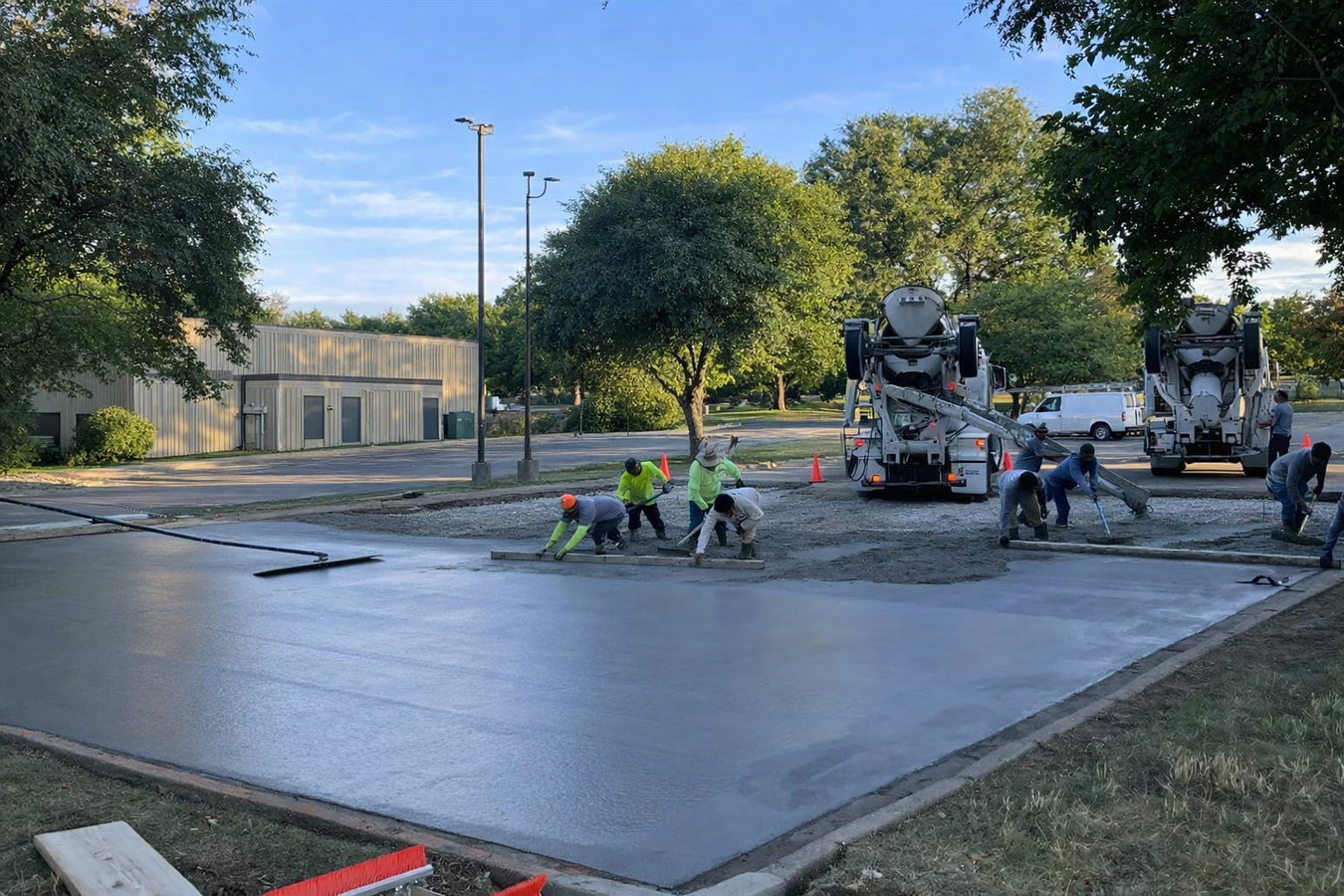
Your parking area takes a beating every day. We build concrete lots that hold up through Arkansas summers, clay soil movement, and years of heavy use.
Concrete parking lot building in Fort Smith means removing the old surface, grading the ground for drainage, and pouring a reinforced slab engineered for local clay soil - most lots take two to five days from demolition to finished pour, plus a week of curing before vehicles can return.
If your current lot is cracking, pooling water after rain, or still unpaved dirt and gravel, a concrete surface solves all of it in one project. Fort Smith property owners dealing with the city's clay soils and summer heat need a surface that stays stable year after year - not one that softens, ruts, or requires constant upkeep.
A concrete lot pairs well with concrete driveway building if you are also upgrading vehicle access to your property. Both projects use the same approach to base preparation and drainage, and scheduling them together can reduce overall project time and cost.
If you see cracks wider than a quarter-inch spreading in a web-like pattern, the surface has failed structurally, not just cosmetically. Patching individual cracks will not fix the problem. In Fort Smith, this kind of widespread cracking often traces back to clay soil shifting beneath the slab over years of wet and dry cycles.
Standing water after a rainstorm means the surface is no longer draining the way it should - either because it has settled unevenly or the original drainage design was poor. In Fort Smith's spring storm season, a parking area that holds water becomes a safety hazard and speeds up surface deterioration.
When the edges of a parking area start to chip or break off in chunks, it usually means the base underneath has eroded or the original pour was too thin at the borders. This is common in older Fort Smith properties. Once the edges go, the deterioration tends to spread inward quickly.
Many older commercial and residential properties in Fort Smith still have gravel or packed-dirt parking areas. These surfaces track mud into buildings, create dust in dry weather, and can create liability issues. A concrete surface solves all of those problems in one project.
We handle every phase of concrete parking lot construction - site demolition, subgrade grading, base preparation, reinforced concrete pour, and expansion joint cutting. Every lot starts with proper base preparation suited to Fort Smith's clay soils, because the ground beneath the slab is what determines how long it lasts. If your property also needs updated vehicle access, we can tie a new lot project into concrete driveway building on the same visit to keep the scope organized.
We also work on properties that need structural concrete alongside surface work. If you are adding a new structure near the parking area, we can coordinate concrete footings as part of the same project to avoid scheduling two separate crews. Every parking lot we build is permitted through Fort Smith's Development Services, so the project closes with an official inspection on record.
Suited for businesses and multi-unit properties replacing a worn or failed surface with a new reinforced concrete slab.
Suited for property owners adding a paved parking area to a site that currently has gravel, dirt, or no defined parking at all.
Suited for businesses or landlords adding parking spaces to an existing concrete or asphalt surface.
Suited for homeowners who need a durable, low-maintenance surface for multiple vehicles, trailers, or equipment.
Fort Smith summers regularly push above 95 degrees Fahrenheit, and that heat is genuinely hard on asphalt. Asphalt softens in extreme heat, leaves tire marks, and requires annual seal coating to stay functional. Concrete stays rigid through Arkansas summers and needs far less upkeep over its lifespan. On the other side of the calendar, Fort Smith winters bring freeze-thaw cycles that crack poorly built surfaces from the inside out - water seeps into surface pores, freezes, expands, and breaks the surface apart. A lot built with proper drainage and sealed correctly handles both extremes without constant attention.
The clay soils throughout the Fort Smith area add another layer of complexity. Clay swells when it rains and shrinks during dry spells, and that movement is what destroys lots built on a weak base. We build lots that work here - not just on paper. Homeowners in Van Buren and property owners in Greenwood deal with the same soil and weather conditions, and we serve both areas with the same approach.
We take your call and schedule a site visit, usually within one business day. At the visit, we measure the area, assess soil and drainage conditions, and discuss your goals before giving you a written estimate.
After the site visit, you receive a written breakdown covering demolition, base prep, the pour, and finishing. Once you sign off, we apply for the required Fort Smith permit - we handle this for you, no phone calls to the city needed on your end.
Before any concrete is poured, the crew removes the old surface, grades the ground for drainage, compacts the soil, and lays a gravel base layer. This is the most important phase - it determines whether your lot lasts 10 years or 40.
On pour day, forms are set, the slab is poured and finished, and expansion joints are cut into the surface before it hardens. Plan to keep vehicles off the lot for at least seven days. When the concrete is ready, we walk the lot with you and explain the care instructions before closing the job.
Free written estimate. No pressure. We reply within one business day.
(479) 377-0983We size every base layer and slab thickness to the actual soil conditions on your lot - not just the minimum that looks right on paper. Clay soils in Fort Smith require more base preparation than sandy or loam soil, and we account for that on every project.
We pull the Fort Smith Development Services permit before any work begins on your lot. The permit triggers a city inspection, which gives you an independent confirmation that the work was done to code - not just our word for it.
Asphalt softens and ruts in Fort Smith heat. Concrete does not. The Federal Highway Administration recognizes concrete as the preferred pavement for high-heat climates, and our lot builds are designed to take advantage of that durability for your property.
We work throughout Fort Smith and across the surrounding area - including Van Buren, Greenwood, and communities as far as Fayetteville and Bentonville. You get a contractor who knows local permit offices, soil conditions, and weather patterns, not a crew learning your market on your project.
Every parking lot we build is permitted, inspected, and engineered for the soil and climate conditions of this specific part of Arkansas. That combination - local knowledge, proper permitting, and correct base preparation - is what separates a lot that lasts decades from one that starts cracking within a few years.
Pour structural footings for decks, additions, and new construction on Fort Smith's clay-heavy soils.
Learn moreReplace or build a residential driveway with a reinforced concrete slab sized for local soil conditions.
Learn moreContractor schedules fill fast once the weather breaks. Call today or request a free estimate online and lock in your project date.